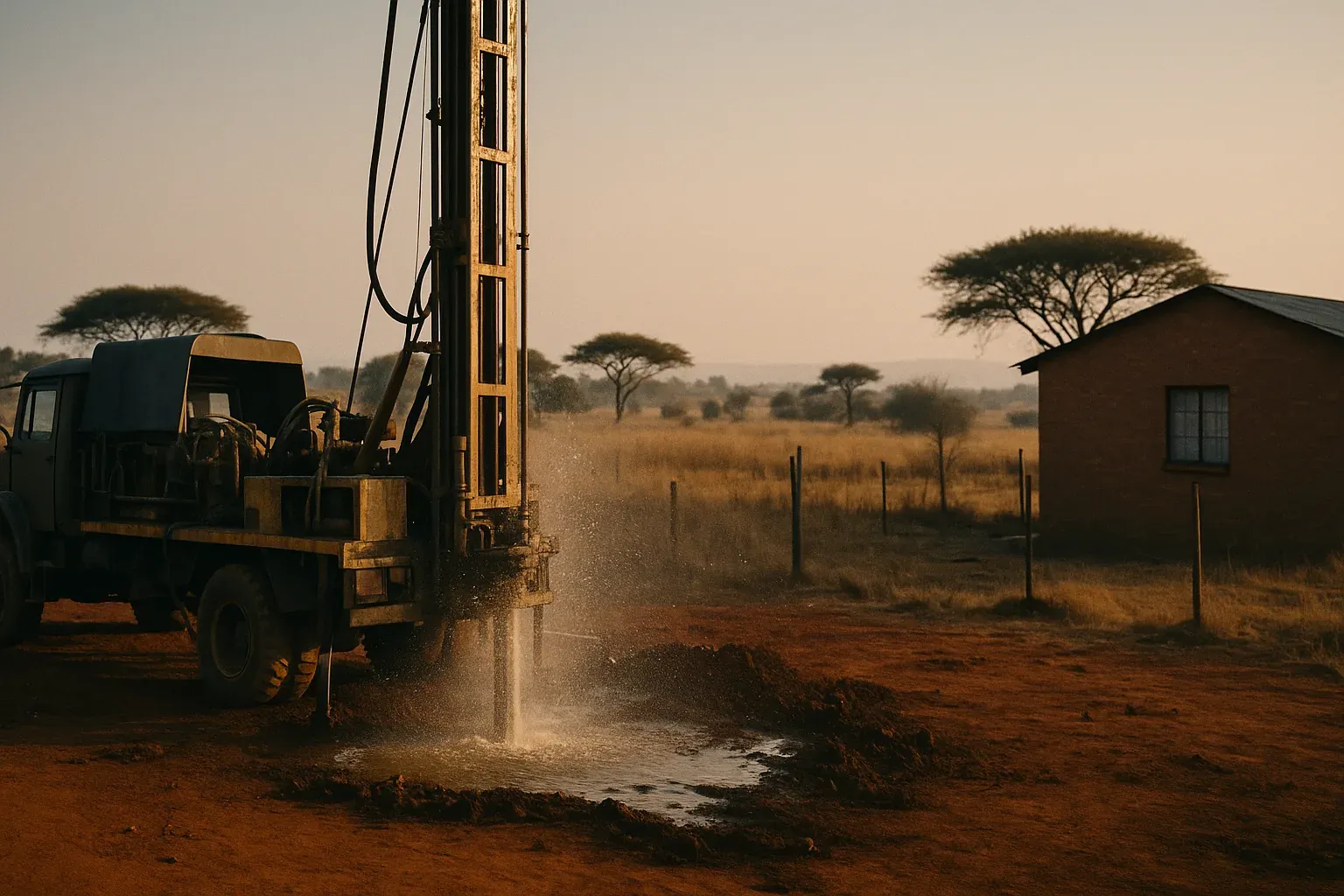
A domestic borehole in South Africa typically costs R20,000–R60,000 to drill and is legal for most residential use — that's the short answer. The fuller picture involves a real five-stage process and legal rules with more nuance than one line can cover, so here's the honest, no-sales-pitch version of what's actually involved before you call anyone for a quote.
How Does Borehole Drilling Actually Work?
Drilling a borehole isn't "make a hole, hit water." A properly done job runs through five distinct stages, and skipping any of them to save money is where most of the horror stories in this space come from.
- Geophysical site survey. A specialist assesses your property to find the most likely spot to hit a reliable aquifer — the underground layer of water-bearing rock or sand your borehole actually draws from — rather than guessing. This is the step people most often skip to save a few thousand Rand, and the step that most often costs them far more later when the borehole underperforms.
- Drilling and casing. The borehole is drilled to the depth needed — commonly somewhere between 30 and 150 metres in South Africa, depending on how deep the local water table sits — and lined with casing to stop the shaft collapsing.
- Yield testing. Once water is reached, the driller tests how much water the borehole can reliably produce, so you know what you're actually working with before committing to a pump.
- Water quality testing. A sample goes to a lab to check whether the water needs filtration or treatment before it's used for drinking, washing, or irrigation.
- Pump and infrastructure. A submersible pump, storage tank, and plumbing tie the borehole into your property's water supply.
Can I Drill My Own Borehole?
It's a real question people ask, so let's actually answer it. Technically, nothing stops you buying a hand-auger kit and having a go. In practice, it's not something we'd recommend for a proper household water supply.
The part that trips people up isn't the digging — it's the siting. Finding a spot that will actually hit a reliable aquifer needs a geophysical survey, which is exactly the specialist step a DIY approach usually skips. Get that wrong and you end up with a borehole that runs dry, collapses, or draws water you wouldn't want to drink. Most people who try the DIY route end up calling a professional driller afterwards anyway, which usually means paying for the DIY attempt and the professional job.
Is a Borehole Actually Worth It For Your Property?
Honestly, it depends. A borehole is a real, front-loaded cost — see our drilling prices page for actual Rand ranges rather than a vague "get a quote" — and there's no guaranteed yield until the driller has actually drilled.
It tends to be a stronger option if your municipal water supply has become unreliable or increasingly expensive, and you're planning to stay on the property for years rather than months. It's a weaker option if you're not sure how long you'll own the property, or if the groundwater picture in your specific area is already known to be poor. A decent driller's site survey should give you an early read on that before you've committed real money.
Once you've decided a borehole makes sense, the next real decision is who drills it — we've written a full, honest breakdown of how to choose a borehole drilling company you can actually trust, rather than just picking whoever answers the phone first.
What Are the Real Downsides of a Borehole?
A site that only talks about the upside of a borehole isn't being straight with you, so here's the honest list:
- Real upfront cost — site survey, drilling, casing, pump, and often water treatment, none of which are optional line items you can skip.
- No guaranteed yield — you don't know exactly what you're getting until the borehole is actually drilled and tested.
- Ongoing maintenance — filters, pump checks, and occasional cleaning are a normal part of ownership, not a sign something's gone wrong.
- Water quality isn't automatic — borehole water can carry natural minerals, sediment, or microorganisms depending on your area's geology. A lab test tells you what's actually in it, and treatment (if needed) is usually a modest add-on, not a major one.
- Yield can drop over time — through drought, over-abstraction in the area, or gradual siltation. It's not the norm for a properly surveyed borehole, but it does happen, and a good site survey reduces the risk rather than eliminating it.
None of this makes a borehole a bad idea. It just means it's a real decision with real tradeoffs, not a purely upside purchase.
Is Borehole Drilling Legal in South Africa?
Yes, for most residential use — groundwater use for a single household typically falls under a general authorisation and doesn't need individual registration. But "yes, mostly" isn't the same as "no rules apply," and there's a real, current registration deadline (WARMS) that affects some borehole owners. We've written the full, honest breakdown — including who it actually applies to — on our borehole regulations page, rather than trying to compress a legal topic into a paragraph here.
Already Have a Borehole?
If you're here because something's gone wrong with an existing borehole rather than planning a new one, this page isn't really written for you. Head to our borehole maintenance guide if you're due for a service, or our borehole repairs guide if something's actively not working.
BoreholeDrillingSA.co.za is an independent South African information resource for borehole drilling, repairs, and maintenance — helping homeowners and businesses understand their options and compare local drilling contractors. We don't drill boreholes ourselves; think of us as the research step before you start calling companies for quotes.
Ready to move forward? Get quotes from local drillers — no pressure, and it takes under a minute to tell us what you need.